Posts

Smoke Testing In Software Qa Testing?

Image
  The term "smoke test" originates out of the custom of workers in the construction industry injecting smoke into pipelines for water to ensure that they don't leak and prevent flooding.   In the realm in the realm of science and technology, expression smoke test is derived from testing hardware.   A brand new device is connected and the power is switched on.   If smoke is coming out of the board power is shut off, and the testing ceases. In the realm of software Smoke testing tests the basic capabilities of a software program to ensure that it is suitable to be tested further.   This will prevent an QA team from attempting conduct a thorough test on software that isn't able to perform basic functions. Testing for smoke in technology is widely utilized to test features of products within a time limit.   If features aren't working or there are software bugs that aren't fixed tests are stopped to ensure that time is not wasted in installing or testing ...
Smoke Testing vs. Regression Testing: What's the Difference and When to Use Each?

  Smoke testing and regression testing, both play a crucial role in ascertaining whether the software product or application that is being developed is working as per the required expectations or not. Smoke testing is conducted in the initial stages of software development to uncover any major defects and fix them. It is carried out quickly. Regression testing ensures that new changes or updates introduced in the code do not alter the existing functionalities of the application.  In this article, you will get to know the differences between smoke testing and regression testing.   What is smoke testing? The pre-production software is tested by developers and testers so that specific issues can be identified and fixed. Before moving on to further stages of the Software Development Life Cycle (SDLC) process, smoke testing is quickly performed to fix any issues or bugs early on in the software development process. Before the software product or application goes through f...

Smoke Testing vs Sanity Testing Explained

Image
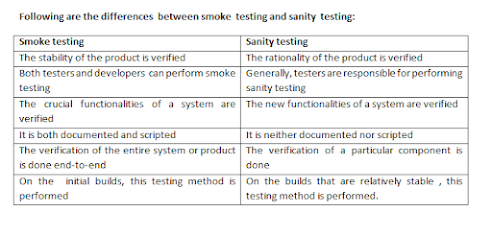
 What is smoke testing? Once the software build has been developed, the smoke testing process takes place and if there are any issues then they are fixed. This testing method makes sure that all the program's core functionalities are working cohesively and smoothly.  Specific errors are eliminated in the software development process, which, in turn, helps in carrying out the software testing process more efficiently. Integration related issues are detected and thus specific insights are provided in the early stages of the software development activities. Smoke testing can be conducted in both manual and automated mode. What is sanity testing? Whenever new modules are being added to the existing software build, sanity testing is conducted to verify whether the build is still working as expected and whether it can be passed on to further levels of testing. Sanity testing is considered to be a subset of regression testing and hence the quality of regressions that has been worked ...

Smoke Testing - Types, Process, Tools & More!

Smoke testing has an important role in software development and testing as it is focused on working on the software build. It ensures that the software builds are working as expected. It also ensures whether the crucial functions of the written program are working as expected or not.  Smoke testing does the initial testing of the product and fixes the issues accordingly, before the product is tested through the other software testing phases. In this article, you will get to know the types of smoke testing along with the process and tools for conducting it. What is smoke testing? It is a testing method that verifies whether the deployed software build is stable or not. It provides a sort of confirmation to the QA teams so that they can proceed with further phases of testing. It also makes sure whether the build that has been received from the development team functions properly or not. The most crucial functions of a product or application are tested by this method. Types of smoke t...

From Smoke Testing to User Acceptance: A Comprehensive Guide to Software Testing Stages

Image
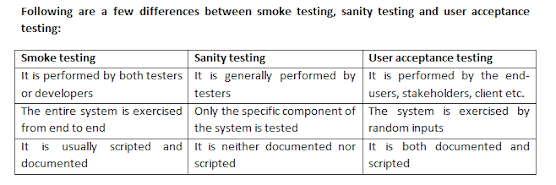
Smoke testing, sanity testing and user acceptance testing are considered to be important methods of the Software Testing Life Cycle (STLC) process. Smoke testing is focused on ensuring that the crucial functionalities are working as expected. Sanity testing is conducted after the successful completion of smoke testing and finally, user acceptance testing is conducted at the final phase of the software testing process to ensure that the product is built as per the user's requirements. In this article, you will get to know about smoke, sanity and user acceptance testing. 1. Smoke Testing: What is Smoke testing? This testing method is a subset of acceptance testing. This testing method verifies whether the deployed software build is stable or not. It makes sure that the system's important functionalities are working as expected or not. Early major issues are detected, so that resources and time can be saved to a great extent. Smoke testing lets the team know whether the product or...

Demystifying Smoke Testing: Ensuring the Stability of Your Build

The platform of smoke testing ensures that the build is being properly tested and that the crucial functionalities function as intended. A concise and fast regression test of essential functions is carried out by this testing method. The product is being demonstrated to know that it is being prepared for further tests and checks.  The blocker bug can be found early on by performing smoke testing and thus preventing the test engineer from being idle. The independent testable modules can also be examined accordingly. In this article, you will get to know a detailed understanding of the significance of smoke testing.   What is smoke testing? It is a testing method wherein the fundamental aspects of a software program are tested in the initial stages of software development. Minor issues are identified and fixed. At a deeper level, smoke testing is conducted to also ensure whether the deployed software build is stable or not. The software's functionality is verified by executi...

Smoke Testing for Mobile Applications: Ensuring Stability in a Mobile-First World

  In a world where the majority of digital interactions occur on mobile devices, the stability and initial quality of mobile applications have become paramount. Enter smoke testing, a preliminary testing approach that helps ensure only stable builds go through in-depth testing. For mobile apps, smoke testing has particular nuances that make it an invaluable tool for developers and QA teams alike. 1. What is Smoke Testing? Smoke testing, often called "sanity testing", is a superficial level of testing carried out to determine if a build is stable enough for further, more exhaustive testing. It gets its name from the analogy of “turning on the system to see if smoke comes out”, indicating a major failure. 2. Why is Smoke Testing Crucial for Mobile Applications? Diverse Device Ecosystem : Mobile devices come in myriad screen sizes, OS versions, and hardware capabilities. A basic assurance that an app runs across these variances is crucial. User ...